

Living in the Washington, D.C. metropolitan area often means crossing state lines several times a day. You might live in Montgomery County, Maryland, work in Northern Virginia, and meet friends for dinner in the District. While the physical transitions are seamless, the legal boundaries are rigid. If you find yourself facing an assault or domestic violence charge, the specific side of the Potomac River where the incident occurred will dictate everything from the name of the crime to the potential time you might spend in jail.
Maryland and Virginia have distinct legal philosophies regarding personal conflict and domestic disputes. Understanding these differences is essential for anyone trying to manage the complexities of the local court systems.
Assault Definitions in Maryland
In Maryland, the law does not typically use the term “battery” in its charging documents. Instead, the state uses the umbrella term “assault” to cover both the threat of harm and the actual physical contact. Most common cases are filed as second-degree assault. This is a misdemeanor, but do not let that label mislead you. In Maryland, a second-degree assault conviction carries a maximum penalty of ten years in prison and a fine of up to $2,500.
Maryland also allows for a “domestically related” finding. If an assault occurs between people in a specific type of relationship, such as spouses or people living together, the prosecution can ask the judge to designate the case as domestic violence. While this does not necessarily increase the maximum prison sentence, it carries significant collateral consequences, including the loss of firearm rights and different requirements for parole or probation.
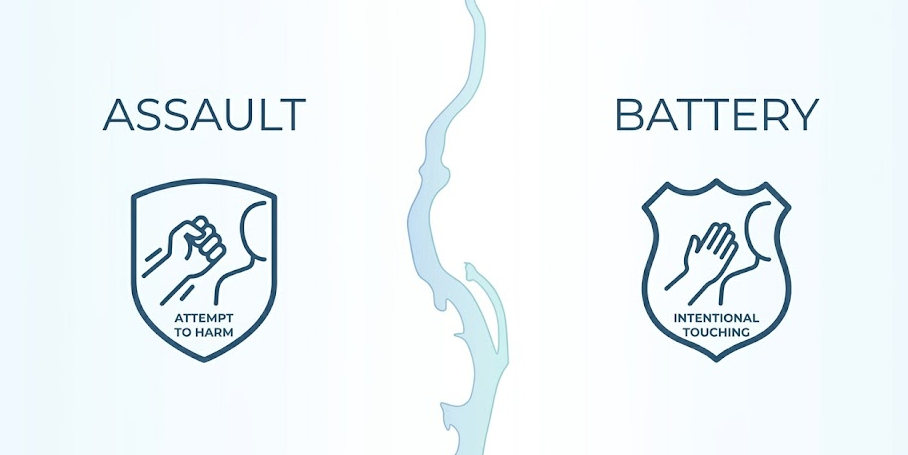
How Virginia Classifies Assault and Battery
Virginia follows a more traditional common law approach by separating the two concepts, though they are usually charged together as “assault and battery.” Under Virginia Code, an assault is an attempt or offer to do bodily harm, while battery is the actual intentional touching of another person without their consent.
Most simple assault and battery charges in Virginia are Class 1 misdemeanors. These carry a maximum of 12 months in jail and a fine of $2,500. While the maximum jail time is lower than Maryland’s ten-year limit for misdemeanors, Virginia is often perceived as having a more rigid sentencing culture.
The Commonwealth takes a very strict stance when these incidents involve “family or household members.” A separate statute covers assault and battery against a family member, and Virginia law often requires a mandatory cooling-off period and an immediate emergency protective order upon arrest. Because the penalties for these crimes can include jail time and a permanent criminal record, building a strong Virginia assault and battery defense is vital for those facing charges in the Commonwealth.
The Mandatory Arrest Policy in Virginia
One of the most striking differences between the two states is how the police handle the initial call. Virginia has a “pro-arrest” or mandatory arrest policy in domestic violence situations. If a police officer responds to a domestic call and finds probable cause to believe that an assault occurred, the officer is generally required to make an arrest. This is true even if the alleged victim does not want to press charges or asks the officer to leave.
Maryland officers have slightly more discretion, though most departments have internal policies that strongly encourage an arrest if there are signs of physical injury. However, Virginia’s law is written into the state code, making it much harder for officers to walk away without taking someone into custody.
Diversion Programs and First-Time Offenders
Both states recognize that some conflicts are the result of isolated incidents or underlying issues like substance abuse or mental health struggles. Maryland offers several ways to resolve cases without a permanent conviction, such as “Probation Before Judgment” (PBJ). If a defendant receives a PBJ, they are placed on probation, and if they complete the terms successfully, the conviction is not entered onto their record.
Virginia has a specific “First Offender” statute for domestic assault cases. Under Virginia Code § 18.2-57.3, a court can defer a finding of guilt for a first-time domestic violence offender. The defendant must usually complete a batterer’s intervention program and stay out of trouble for a set period. If they succeed, the charge is dismissed. However, unlike Maryland’s PBJ, a dismissed case under Virginia’s first-offender program cannot currently be expunged from a person’s criminal history, meaning the arrest record remains visible.

Protective Orders Across State Lines
Protective orders, often called restraining orders, are handled differently in each jurisdiction as well. In Maryland, these are divided into “Interim,” “Temporary,” and “Final” protective orders. They can last up to a year, with the possibility of an extension.
Virginia issues “Emergency,” “Preliminary,” and “Permanent” protective orders. An Emergency Protective Order in Virginia is often issued automatically by a magistrate when a domestic assault arrest is made, even if the alleged victim has not requested one. This order typically lasts for 72 hours, giving the parties time to separate and seek a longer-term solution through the Juvenile and Domestic Relations District Court.
Why Local Knowledge Matters
The legal systems in Maryland and Virginia are not just different in their written laws; they are different in their courtroom cultures. The way a prosecutor in Prince George’s County evaluates a case might be entirely different from how a prosecutor in Fairfax County views the same set of facts.
If you are navigating the legal system in the DMV, you cannot assume that the rules in one state apply to the other. The penalties are high, and the long-term impact on your employment and reputation can be permanent. Having a legal team that understands the nuances of both Maryland and Virginia law ensures that your rights are protected regardless of which side of the state line the police arrived on.