
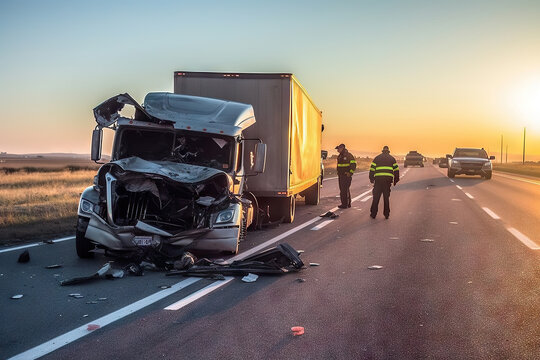
A rear-end collision between two sedans and a crash involving a fully loaded semi-truck might look similar in the first few minutes after impact, but the legal path each one follows is not close to the same. Truck accident claims bring in federal regulations, corporate defendants, and insurance policies that a standard two-car accident case never touches, and that difference shapes nearly every decision that follows.
This guide covers:
• The federal regulations that apply to trucks but not passenger vehicles
• The insurance gap between a typical car policy and a commercial trucking policy
• Why evidence in a truck accident case can disappear faster than in a car accident case
• Who can be held liable beyond the driver
At a Glance
Factor | Standard Car Accident | Truck Accident |
Governing law | State traffic law only | State law plus FMCSA federal regulations |
Typical liable parties | One or two drivers | Driver, trucking company, cargo loader, maintenance provider, and others |
Minimum liability insurance in California | $30,000 per person / $60,000 per accident | Generally $750,000 combined single limit for trucks over 10,001 lbs |
Key evidence | Police report, photos, witness statements | Also includes ELD data, black box records, driver logs, maintenance history |
Investigation start | Usually after the claim is filed | Trucking company investigators often arrive within hours |
Vehicle weight | Roughly 3,000 to 4,500 lbs | Up to 80,000 lbs fully loaded |
Federal Regulations Add a Layer of Law That Cars Never Face
A standard car accident claim is built almost entirely on state traffic law, a police report, and the accounts of the drivers involved. A truck accident claim starts there too, but a second body of law sits on top of it. Commercial trucks operating in interstate commerce are regulated by the Federal Motor Carrier Safety Administration, which sets rules covering how many hours a driver can be behind the wheel, how a truck must be inspected and maintained, how cargo has to be loaded and secured, and what qualifications a driver must hold before operating the vehicle at all.
These rules matter because a violation of any of them can serve as direct evidence of negligence in a way that has no equivalent in an ordinary car accident case. A driver who exceeded federal hours-of-service limits, a company that skipped a required maintenance inspection, or cargo that was improperly secured can each become a central piece of the liability argument. None of this exists in a two-car crash, where the analysis usually stops at who ran the light or who was following too closely.
Building a truck accident case around these regulations also requires a different kind of investigation than a car accident claim does. Establishing a hours-of-service violation means reviewing electronic logging device records against the driver’s actual route and stops. Establishing a maintenance failure means requesting the company’s inspection and repair history for that specific vehicle, not just a general statement that the truck was serviced. A car accident case rarely calls for this kind of document-heavy review, since state traffic law and a police report usually cover what actually happened.
The Insurance Gap Is Larger Than Most People Expect
One of the more concrete differences between the two types of claims is the amount of insurance actually available to cover the loss. California’s baseline liability minimum for a passenger vehicle is $30,000 per person and $60,000 per accident, an amount that has not kept pace with the real cost of serious injury treatment. A commercial truck weighing more than 10,001 pounds and hauling non-hazardous freight, by contrast, is generally required to carry $750,000 in combined single limit liability coverage under federal rules, and that figure climbs even higher for hazardous cargo or passenger-carrying vehicles.
That gap changes the entire negotiating dynamic. A car accident claim is frequently capped by how much insurance the other driver happens to carry, and a badly underinsured driver can leave a seriously injured victim with limited options regardless of fault. A truck accident claim usually starts from a much larger insurance pool, but that pool comes with a defense team that has every incentive to protect it. Commercial insurers assign adjusters and, often, outside counsel to truck accident claims specifically because the stakes are higher, and they tend to contest both fault and the value of the claim more aggressively than a personal auto insurer handling a routine two-car collision.
Evidence Moves Faster, and So Does the Other Side
In a typical car accident, the evidence that matters is a police report, some photographs, and whatever the witnesses remember. That evidence generally holds up for a while, and there is rarely a rush to preserve it beyond the usual practicalities. A truck accident case runs on a different clock. Trucking companies often dispatch their own investigation teams to a crash scene within hours, well before the injured party has left the hospital, and their goal from that first hour is to control the narrative and gather evidence that supports the company’s position.
The evidence unique to a truck accident case is also more fragile. Electronic logging device data, black box recordings, and onboard camera footage can be overwritten or deleted within days if no one moves to preserve it, and driver qualification files or maintenance histories can be harder to obtain the longer a case sits unaddressed. This is one of the clearer reasons an injured person benefits from acting quickly rather than waiting to see how an initial settlement offer looks. Someone hurt in a truck crash on the 405 or the 710 is often better served contacting a Los Angeles truck accident attorney early, since evidence that would otherwise support the claim can be gone before an attorney is ever brought in.
Liability in a truck accident case also tends to reach further than the driver alone. Depending on the facts, the trucking company, the vehicle owner if separate from the carrier, a maintenance contractor, or a cargo loading company can all share responsibility for a crash, each with its own insurer and legal team working to minimize what it owes. A standard car accident claim rarely involves more than the two drivers and their respective insurers, which is part of why firms such as ER Lawyers generally approach a commercial truck claim as a more involved investigation from the outset rather than a routine two-party dispute.
Summary
A truck accident claim shares a starting point with a car accident claim, but the similarities mostly end there. Federal regulations, a much larger pool of insurance, fast-moving and easily lost evidence, and a wider set of potentially liable parties all separate the two, and treating a truck accident claim like an ordinary fender-bender case tends to work against the injured person rather than in their favor.
Key Takeaways
• Federal FMCSA regulations apply to commercial trucks and can turn a rule violation into direct evidence of negligence.
• Commercial truck insurance minimums in California are typically many times higher than the state’s passenger vehicle minimum, which changes how aggressively a claim gets defended.
• Evidence like black box data and driver logs can disappear within days, making early action more important than in a standard car accident case.
Recognizing these differences early, rather than after a company’s investigation team has already built its file, protects the strength of the underlying claim.
Frequently Asked Questions
Why is a truck accident claim more complicated than a car accident claim?
Truck accident claims involve federal regulations that don’t apply to passenger vehicles, larger insurance policies, multiple potentially liable parties beyond the driver, and evidence that can disappear within days if it isn’t preserved quickly.
What federal rules apply to truck accidents but not car accidents?
The Federal Motor Carrier Safety Administration regulates commercial trucks operating in interstate commerce, covering driver hours-of-service limits, vehicle maintenance and inspection requirements, cargo loading rules, and driver qualification standards. None of these apply to an ordinary passenger vehicle.
Who can be held liable in a truck accident besides the driver?
Depending on the facts, liability can extend to the trucking company, the vehicle owner if different from the carrier, a maintenance provider, or a cargo loading company, each of which may carry separate insurance coverage.
How much insurance does a commercial truck typically carry compared to a car?
California’s baseline minimum for a passenger vehicle is $30,000 per person and $60,000 per accident. A commercial truck over 10,001 pounds hauling non-hazardous freight is generally required to carry $750,000 in combined single limit coverage under federal rules, and that number is higher for hazardous cargo.
Why does evidence disappear faster in a truck accident case?
Electronic logging device data, black box recordings, and onboard camera footage are often retained only for a limited period and can be overwritten or deleted if no one takes steps to preserve them, unlike a standard police report or set of accident photos.
Does the statute of limitations differ for truck accidents in California?
No. Truck accident claims generally follow the same two-year deadline that applies to most California personal injury claims, though claims involving a government entity carry a much shorter six-month notice requirement.